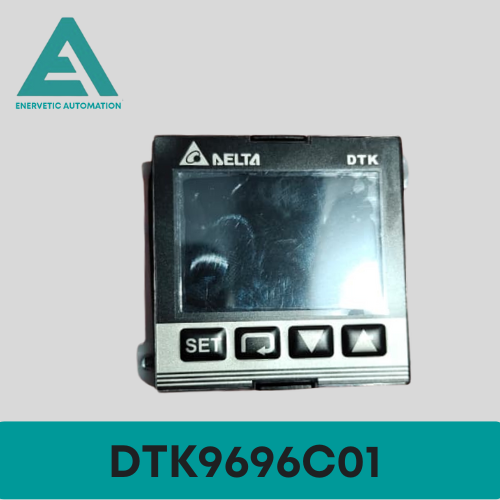
DTK9696C01 | Delta Temperature Controllers About
-
Panel Size: 96 96 mm ( DIN standard) fits standard industrial panel cut-outs.
-
Supply Voltage: AC 100240 V, 50/60 Hz (universal input).
-
Sensor Inputs: Thermocouple types K, J, T, E, N, R, S, B, L, U, TXK and platinum RTD (Pt100, JPt100) selectable by parameter.
-
Display: High-resolution LCD (PV in red, SV in green) for process value and setpoint.
-
Control Modes: PID (automatic), ON/OFF, Manual.
-
Sampling Rate: Typically 0.1 s for fast response.
-
Outputs:
Relay output (e.g., 250 VAC, 5 A resistive),
Voltage pulse output (DC 12 V),
Current output (420 mA) depending on model/code suffix.
-
Alarm Outputs: Usually 12 alarms configurable.
-
PID Features: Auto-tuning PID for temperature regulation and stable control.
-
Operating Conditions: 0 C +50 C ambient, humidity non-condensing.
Versatile Control Modes for Precise RegulationChoose between PID, ON-OFF, or manual control to match your process needs. The DTK9696C01 adapts seamlessly to a variety of industrial applications, ensuring accurate temperature management and stability across your system. Its advanced algorithms provide efficient, responsive regulation for improved productivity and reduced waste.
Exceptional Accuracy and Fast ResponseWith an accuracy rating of 0.5% of full scale 1 digit and a response time under 1 second, the DTK9696C01 delivers precision where it matters most. The broad setting range from -199C to 1300C (K-type thermocouple) accommodates diverse processes, while its digital LED display ensures clear, real-time feedback for quick interventions.
Built for Industrial Durability and SafetyFeaturing sturdy polycarbonate construction, a matte finish, and IP20 protection, this controller resists tough industrial environments. Its compact square design (96x96mm), screw terminal connections, and panel mount functionality make installation straightforward. Integrated dual alarms and overheating protection enhance safety and system reliability.
FAQ's of DTK9696C01 | Delta Temperature Controllers:
Q: How do I connect different input sensors to the DTK9696C01 controller?
A: To connect input sensors, use the terminal block on the controller's rear panel. The DTK9696C01 is compatible with Thermocouple (K, J, T) and RTD (Pt100) sensors, ensuring you match the appropriate terminals and settings for your specific sensor type. Refer to the product manual for wiring guidance.
Q: What control modes are available and when should I use each one?
A: The controller supports PID, ON-OFF, and manual control modes. Use PID for processes requiring stable and precise temperature control, ON-OFF for simple temperature thresholds, and manual mode for direct adjustment without feedback. Selection depends on your specific process requirements and control precision needed.
Q: Where is the best place to install the DTK9696C01 controller?
A: The DTK9696C01 is designed for panel mounting in industrial settings such as process control panels or automation enclosures. Ensure it is installed in an area within its operating temperature (0-50C) and humidity range (35-85% RH, non-condensing) to maintain optimal performance and lifespan.
Q: What process can the DTK9696C01 be used for in industrial automation?
A: It is ideal for process control tasks such as heating, cooling, and maintaining consistent temperature in manufacturing, chemical processing, food production, and laboratory environments. Its flexibility with sensor types and control modes allows it to adapt to varied applications.
Q: How does the dual alarm output function benefit my application?
A: The dual alarm system enhances process safety by providing two independent alerts for temperature deviations, equipment faults, or process anomalies. This allows timely intervention, reducing downtime and preventing potential hazards or product losses.
Q: What are the main benefits of using the DTK9696C01 temperature controller?
A: Key benefits include high accuracy, fast response, flexible input options, reliable PID control, durable construction, and energy-efficient operation (<5VA). These features ensure consistent temperature management with minimal maintenance in demanding industrial environments.




 Send Inquiry
 Send Inquiry

